
CUSTOMER / A LEADING EDUCATIONAL CONTENT AND LEARNING TECHNOLOGY COMPANY
How a leading education company made customer intelligence everyone’s job
A leading educational content and learning technology company unified four cross-functional teams on a single customer intelligence platform, giving researchers, product developers, professional services practitioners, and operations teams the same view of what their users actually need.

4+
cross-functional teams now sharing research in one Dovetail workspace
100s
of qualitative research projects centralized from across the organization
10,000
employee company building learning products backed by shared customer intelligence
The best never guess
Discover how Dovetail can help your team turn customer feedback into decisions.
The 10,000-person company where research shapes every product
This company builds the curriculum, assessments, and digital learning experiences that millions of students engage with each year. With 10,000 employees and a portfolio spanning reading, math, science, and social studies programs across all subjects and grade levels, its mission is to combine digital innovation and research to make learning more engaging and effective for all students.
That mission depends on listening at scale. Every product decision, from a new adaptive reading module to an updated teacher dashboard, is shaped by feedback from educators, curriculum specialists, and district administrators. Getting that feedback from the people who collect it to the people who act on it, spanning product lines, subject areas, and departments, is the organizational challenge that sits underneath any good learning product.
For years, the company had researchers generating substantial qualitative findings. What it needed was a way to make those findings work for everyone: product developers evaluating feature tradeoffs, professional services teams advising school districts, and operations managers translating user problems into engineering priorities. Dovetail became the platform that made this possible.
Four teams, each working from their own map
The company ran multiple specialized research functions within distinct business units: professional learning, core curriculum development, digital product development, and product management and strategy. Each team had developed its own way of working. Separate tag taxonomies, separate project folders, and separate synthesis processes meant that a researcher in the digital product organization had no reliable way to find findings generated by the core curriculum team, even when those findings were directly relevant.
The cost showed up in duplicated effort. Groups working on related problems often had no visibility into what the other had already found. A usability study on teacher-facing tools completed by one team would sit in a presentation deck, inaccessible to the product manager who would have used it months later.
Stakeholders felt the gap most directly. Product managers, professional services leads, and operations staff needed customer evidence to make decisions. Surfacing that evidence meant scheduling time with a researcher, and researchers were already managing multiple concurrent studies. The intelligence existed. Getting to it was the problem.
One team member described the ambition directly: to use Dovetail to share insights more effectively with stakeholders and internal clients “all over the business,” not just within the team that ran the study.
One workspace, each team’s practice intact
Building a shared Dovetail workspace required reconciling four distinct research cultures. Each team had its own vocabulary, its own focus areas, and its own expectations for how findings should be presented. The solution was not to flatten those differences but to create shared scaffolding that made each team’s output discoverable by the others.
“Dovetail is an incredible tool for qualitative work. I can’t praise it enough.”
— Researcher, Digital Product Development
Shared folder structures, naming conventions, and cross-project shared pages gave teams a common infrastructure without erasing their individual practice. A researcher working on professional learning materials could now surface her findings to product managers evaluating the same teacher workflow from a different angle. The workspace grew more navigable with each study added to it.
AI Analysis changed how researchers handled volume. Rather than reading through each transcript manually, they could surface patterns from dozens of interviews, then focus their attention on the findings that most needed interpretation. That freed up time for the kind of synthesis that a cross-functional team could act on.
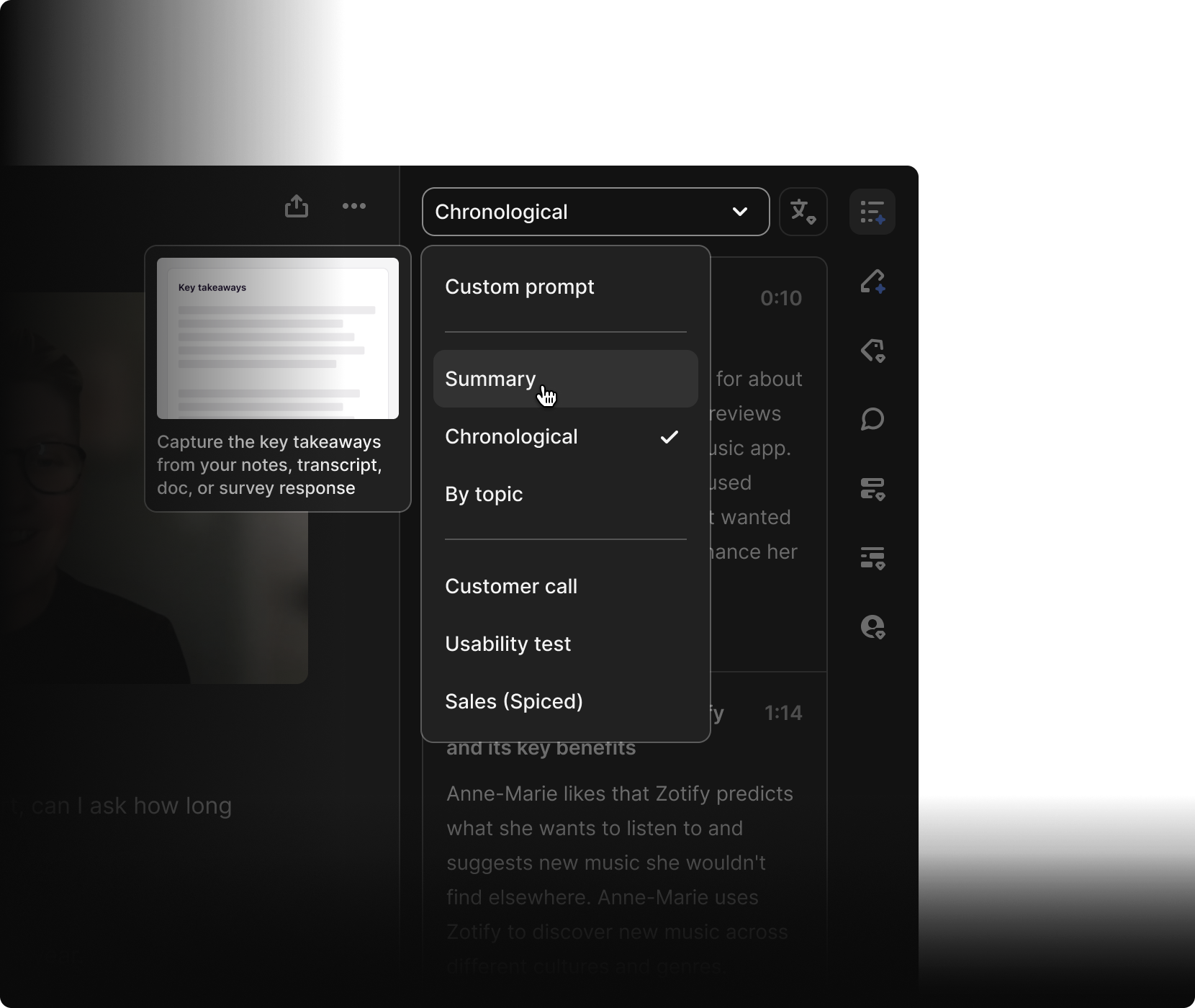
Instead of exporting findings into a presentation deck that circulated once and disappeared, researchers built permanent, searchable pages inside the workspace, organized around product areas and research questions that stakeholders could revisit any time they needed evidence for a decision.
“AI Docs in Dovetail have been helping us in bringing that data to life and consumable not just for ourselves, but for our stakeholders on a more ongoing basis.”
— UX Researcher, Platform Experience Team
From research team to company‑wide asset
The expansion of Dovetail’s reach at this company was not the result of a single planned rollout. It happened because the people using the platform kept finding new ways to push its value further into the organization.
Practitioners on the professional learning team began using the platform in a way the research team hadn’t anticipated. Rather than waiting for synthesized findings to arrive in a shared report, they started uploading their own feedback data directly into Channels—post-session notes, implementation surveys, responses from educators in district engagements—and using AI-generated themes to identify patterns within the programs they were running. Research consumption had turned into research practice.
The advocacy that mattered most came not from power users but from people outside the research function. A Business Operations Manager asked directly: “Is there a way to take the feedback that was uploaded to Dovetail… and then have it automatically upload from Dovetail to Jira and have a Jira ticket created within a Jira project?” She wanted to remove the translation layer between what customers said and what engineers built next.
There is. Dovetail’s Jira integration connects customer findings directly to engineering workflows, so insights don’t stall between the team that surfaces them and the team that acts on them. That is what a customer intelligence platform is designed to unlock.
For a company whose products reach millions of students, the quality of that connection matters enormously. Customer intelligence that is centralized, searchable, and accessible to research, product, professional services, and operations does not just make researchers more productive. It makes each learning product built from that intelligence better.

The best [] never guess
Discover how Dovetail can help your team turn customer feedback into decisions.



FAQs
Yes. For one of our customers, four teams—professional learning, curriculum development, digital product development, and product strategy—moved onto one shared Dovetail workspace, using shared folder structures, naming conventions, and cross-project pages so each team’s findings are discoverable to the others, not locked inside the team that ran the study.
Rather than reading every transcript manually, researchers use AI Analysis to surface patterns across dozens of interviews at once, freeing their attention for the findings that most need human interpretation.
Yes. One professional learning team began uploading its own feedback data—post-session notes, implementation surveys, and responses from educators in district engagements—directly into Channels, then used AI-generated themes to identify patterns without waiting for a research team to synthesize it for them.
Yes. Dovetail’s Jira integration pushes customer findings directly into engineering workflows, automatically creating a Jira ticket from feedback uploaded to Dovetail, so insight doesn’t stall between the team that surfaces a problem and the team that acts on it.
Instead of exporting findings into a presentation deck that circulates once, teams can build permanent, searchable AI Docs organized around product areas and research questions, so stakeholders can return to the evidence whenever they need it, not only when a researcher happens to share it.