
CUSTOMER / A GLOBAL LEADER IN AGRICULTURAL AND CONSTRUCTION EQUIPMENT
How a global agricultural equipment maker unified customer intelligence across 100+ product lines
One of the world's most recognizable agricultural equipment makers is putting the voice of the farmer directly into the hands of product teams across 100+ product lines—using Dovetail to centralize seasonal interviews, field visits, dealer calls, and survey data into a single searchable repository.

30+
researchers and validation engineers on one centralized platform
100+
product lines now informed by a shared customer intelligence repository
25+
post-season farmer interviews per season, each up to 90 minutes, all centralized in Dovetail
The best never guess
Discover how Dovetail can help your team turn customer feedback into decisions.
The equipment maker trusted by farmers in 130+ countries
Few agricultural equipment makers command the recognition this company does. For nearly two centuries, its tractors, combines, and sprayers have worked the fields that feed the world—present on farms in more than 130 countries and trusted across generations. Today, that legacy depends on something less visible than the machines themselves: a deep, continuous understanding of what farmers and operators actually need—season by season, field by field.
A team of more than 20 researchers and product validation engineers sits at the center of that effort. Their job is to capture the voice of the customer and make sure it reaches the engineers and product owners who design and refine the equipment. It's a significant undertaking. Their remit spans more than 100 distinct product lines: tractors, sprayers, planters, tillage systems, precision agriculture software, and everything in between.
The breadth of that work reflects the scale of the organization. A single field visit can surface feedback on 30 different products in one conversation with one operator. A post-season interview program runs to 25 or more sessions per year, each lasting up to 90 minutes. Alongside those interviews, the team manages a continuous stream of input from onboarding calls, weekly dealer conversations, email correspondence, and structured survey data collected through every phase of the growing season.
The intelligence is rich. Getting it to the product teams who need it—quickly, reliably, and without losing nuance—had long been harder than it needed to be. Dovetail's how they changed that.

The challenge: routing insights from 100+ product lines to the teams that needed them
Before Dovetail became their research home, customer intelligence was scattered by necessity. Researchers saved interview recordings to shared drives, managed analysis in spreadsheets, and kept notes in personal files. Post-season interviews—the most structured and comprehensive source of farmer feedback in the calendar—were conducted carefully, but synthesizing them was slow and manual: watching recordings again, re-reading transcripts, extracting themes by hand.
The structural challenge ran deeper than tooling. A researcher returning from a field visit might have gathered meaningful feedback on 30 different products in a single afternoon. Each of those product lines had its own team of engineers waiting for insights. Getting the right findings to the right people, without duplicating effort or losing detail in translation, had no clean answer.
The continuous feedback streams added complexity. The team received input from weekly dealer calls, customer onboarding conversations, dealer emails, and Qualtrics surveys—each in a different format, each requiring separate effort to process. A product owner wanting to understand how operators felt about a specific feature had no reliable way to find out without going back to the researcher who had collected the data.
The ambition the team set out with was straightforward: Dovetail would be the one place for all insights to live—not just a storage system, but a living repository that product owners and engineers could draw from directly.

The solution: from raw transcripts to searchable answers in seconds
The team built a Dovetail workspace structured around the complexity of their data. Research projects hold everything together: post-season farmer interviews, usability test recordings, onboarding calls, survey exports, and the steady flow of dealer feedback that arrives throughout the growing season. A tag taxonomy spanning the full product range means that a single recording covering multiple product lines can be properly attributed and surfaced when any of those teams needs it.
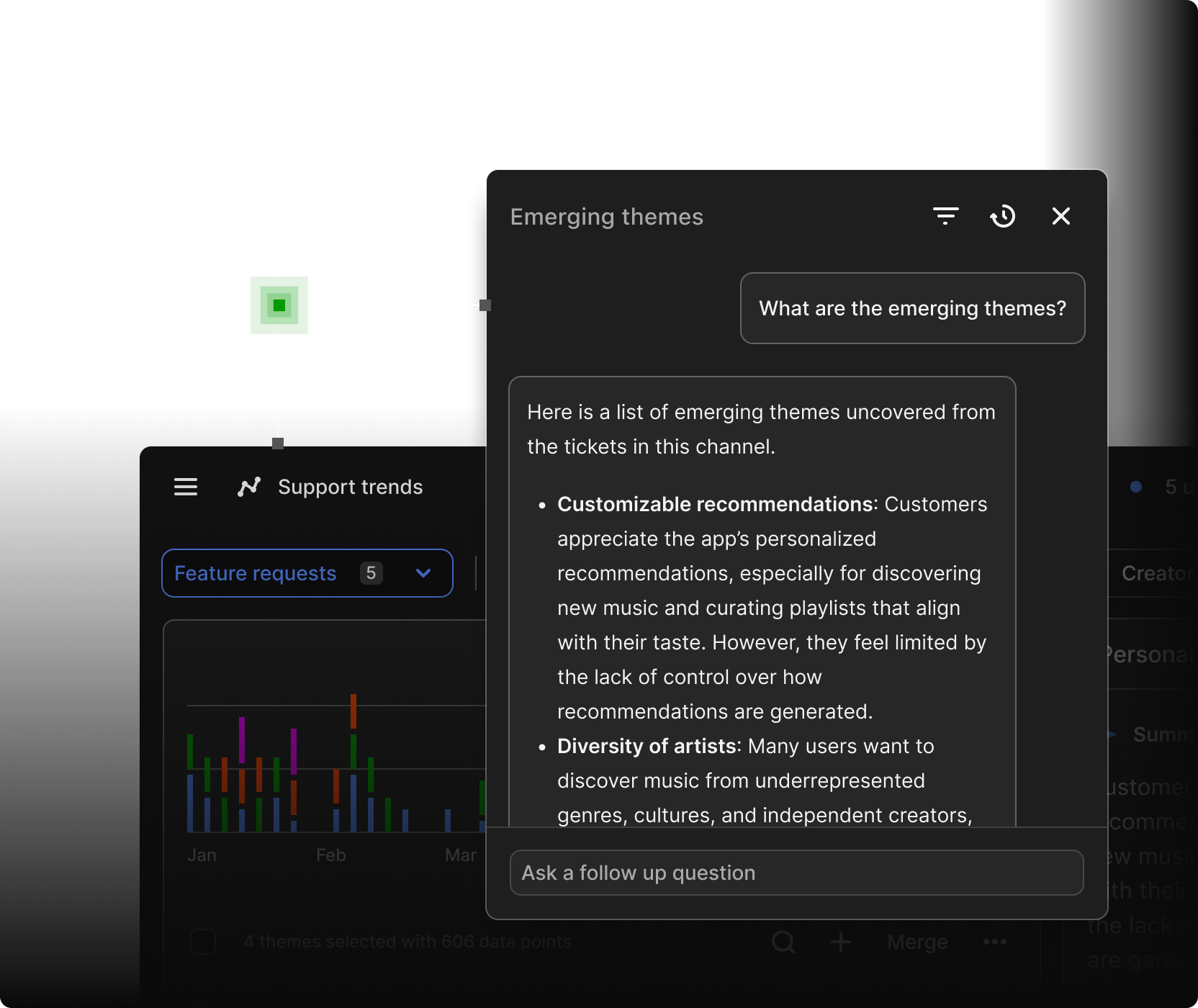
Chat changed the daily rhythm of analysis. Where a researcher previously had to work back through every recording to find what farmers said on a specific topic, they can now ask the question directly and get a cited answer in moments.
"Instead of reading all the way through each transcript or watching each video again, I would simply ask the chat box what people said about certain topics, which was much faster… it cuts down the time that I have to spend creating my reports."
— UX Researcher
The same approach is transforming how product validation engineers work. Engineers who conduct seasonal studies—pairing Qualtrics quantitative surveys with qualitative follow-up interviews—are using Dovetail to bring those sources together and interrogate them with AI. The goal is to ask questions the survey tool alone could never answer: not just what percentage of operators prefer a given feature, but why, and how that preference evolved across a full season of use in the field.
"I can't ask Qualtrics those things. But Dovetail can take that feedback, process it, and analyze it—and when I ask that question, it can answer it."
— Product Validation Engineer
The payoff: farmer feedback attributed and traceable, available to every product owner on demand
The measure of a customer intelligence platform isn't how well the research team uses it—it's how far the intelligence travels. At this company, the ambition is for Dovetail to become the connective tissue between every customer conversation and the product team that needs to act on it.
The product validation supervisor runs a weekly internal Dovetail standup, where researchers and engineers share what they are learning and work through how to structure findings across a sprawling product portfolio. That rhythm—built around the tool, not around emailed reports or slide decks—is shifting how the organization relates to customer knowledge. When a product owner wants to know what farmers said about a specific feature last season, the answer is in Dovetail: attributed, timestamped, and traceable to the specific interview or field visit it came from.
The next phase extends the flow of continuous feedback further. The team's building out Channels to pipe in structured data from Qualtrics surveys and customer feedback forms—creating an always-on layer of intelligence that runs alongside the seasonal research program. Two distinct workspaces built up separately across different divisions of the business, consolidated into one—creating a single workspace where a researcher, an engineer, or a product manager can ask a question and get an answer grounded in what real customers actually said.
That vision—every product team in one of the world's largest manufacturing organizations making decisions grounded in verified customer intelligence rather than gut feel—is precisely what Dovetail's Customer Intelligence Platform is built for.

The best [] never guess
Discover how Dovetail can help your team turn customer feedback into decisions.



FAQs
Dovetail tags a recording that touches multiple product lines so it reaches every team that needs it, instead of getting lost in a shared drive. For one of our customers, a single field visit could surface feedback on 30 different products in one conversation, each one routed to the right engineering team.
Chat lets researchers ask what customers said about a topic and get a cited answer in moments, instead of rewatching every recording or rereading every transcript. One UX researcher described asking “the chat box” as “much faster,” adding that it “cuts down the time that I have to spend creating my reports.”
Yes. Teams can pair quantitative survey data, from tools like Qualtrics, with follow-up interviews in Dovetail, using AI to go beyond raw percentages and surface why customers feel the way they do. As one researcher put it, “I can’t ask Qualtrics those things. But Dovetail can take that feedback, process it, and analyze it—and when I ask that question, it can answer it.”
Yes. One of our customers had built up two distinct workspaces separately across different divisions and consolidated them into one, so a researcher, an engineer, or a product manager in either division can now ask a question and get an answer grounded in the same customer data.
Yes. Answers in Dovetail are attributed, timestamped, and traceable back to the specific interview or field visit that produced them, so a product owner asking what farmers said about a feature last season gets a sourced answer instead of relying on gut feel.