
CUSTOMER / A GLOBAL MANAGEMENT CONSULTING FIRM
How a global management consulting firm turned single-team research into a self-serving intelligence system for 300+ practitioners
At one of the world's most recognized management consulting firms, insights created by one researcher are now discovered, reused, and built upon by teams across a 50,000-person organization. Designers, consultants, and product managers now self-serve research they didn't commission and couldn't find before.

300+
practitioners across research, design, and consulting in the firm's Dovetail community
500+
data points centralized from a single observational research round
75+
practitioners enrolled in a single internal training session in 2025
The best never guess
Discover how Dovetail can help your team turn customer feedback into decisions.
The firm where insights are the product
One of the world's most recognized management consulting firms employs more than 50,000 professionals across every major industry and region. Its entire value proposition rests on a single premise: that its people see patterns faster, reason more rigorously, and synthesize complexity better than anyone else in the room. That reputation is built insight by insight, engagement by engagement, across thousands of projects every year.
What's less visible is the research that happens inside the firm itself, into how its own people work, what tools and platforms they need, and how the organization can run more effectively at scale. A lean team of researchers, designers, and knowledge practitioners drives that effort. Their remit spans the internal products and platforms that hundreds of thousands of professionals depend on daily.
For years, the firm had Dovetail. But the real shift came when that small research group decided to treat internal adoption as a product problem. They built templates, established naming conventions, trained hundreds of practitioners, and built a community around shared standards. The result is an intelligence system that grows more valuable with every study added to it. Consultants, product managers, and designers across the organization now draw from research that researchers completed years earlier, surfacing insights they never would have found working alone.
That's not just tool adoption. That's customer intelligence compounding at scale.

The challenge: hundreds of projects, no connective tissue
The firm's Dovetail workspace grew organically, and with that growth came sprawl. Hundreds of projects lived across the workspace, organized by individual preference rather than any shared structure. A researcher returning from a discovery sprint would know exactly what they had found. A colleague in a different practice area, working on a related problem months later, had no reliable way to find it.
The structural problem ran deeper than folder organization. Researchers, designers, and product managers were operating in separate workflows, rarely aware of what the others had produced. Consultants, a significant portion of the firm's internal research audience, were rarely connected to the knowledge being generated at all. The research team maintained an internal Slack channel for more than 300 practitioners, but getting those practitioners to engage with existing research rather than starting from scratch was harder than it needed to be.
Presenting findings compounded the challenge. Even the most committed advocates in the research team defaulted to slide decks for stakeholder readouts, acknowledging the gap directly: the platform that could show context, nuance, and the actual voice of the participant was being set aside for a PowerPoint. Internal knowledge was locked in files that no one was searching.
Observational research made the stakes tangible. A single field study could generate 500 or more data points. Making sense of that volume, routing findings to the right teams, and keeping them discoverable for future projects required a fundamentally different approach.

The solution: a 300-strong community and a workspace built to compound
The research team treated the workspace like a product they were shipping to internal users. They built a shared template library, each project pre-populated with the firm's standard research plan structure, so any researcher could begin a study with the right scaffolding already in place. Naming conventions, folder hierarchies, and firm-specific tag taxonomies followed. They embedded the firm's internal vocabulary directly into the workspace's custom context, so that Chat would understand the organization's language the moment someone opened a query.
The reuse effect became the most compelling proof of what they'd built. A set of foundational interviews, uploaded by one researcher years earlier, had been accessed and built upon by at least five other researchers working on related problems. Each brought different questions and different synthesis goals. Each walked away having saved hours they would otherwise have spent going back to the source.
"People would come to me and say, 'You saved me so many hours of research. I was able to just use your videos and add my own tags.'"
— Research Operations Lead
That kind of compound return only happens when the workspace is structured well enough to be discoverable. Training became the mechanism for spreading that standard. Quarterly sessions brought together researchers, designers, and other practitioners — sometimes hands-on, sometimes a broader demonstration of new capabilities. A session in late 2025 drew more than 75 registrants. The goal was never just feature literacy. It was shifting the culture from "I have research" to "we have research."
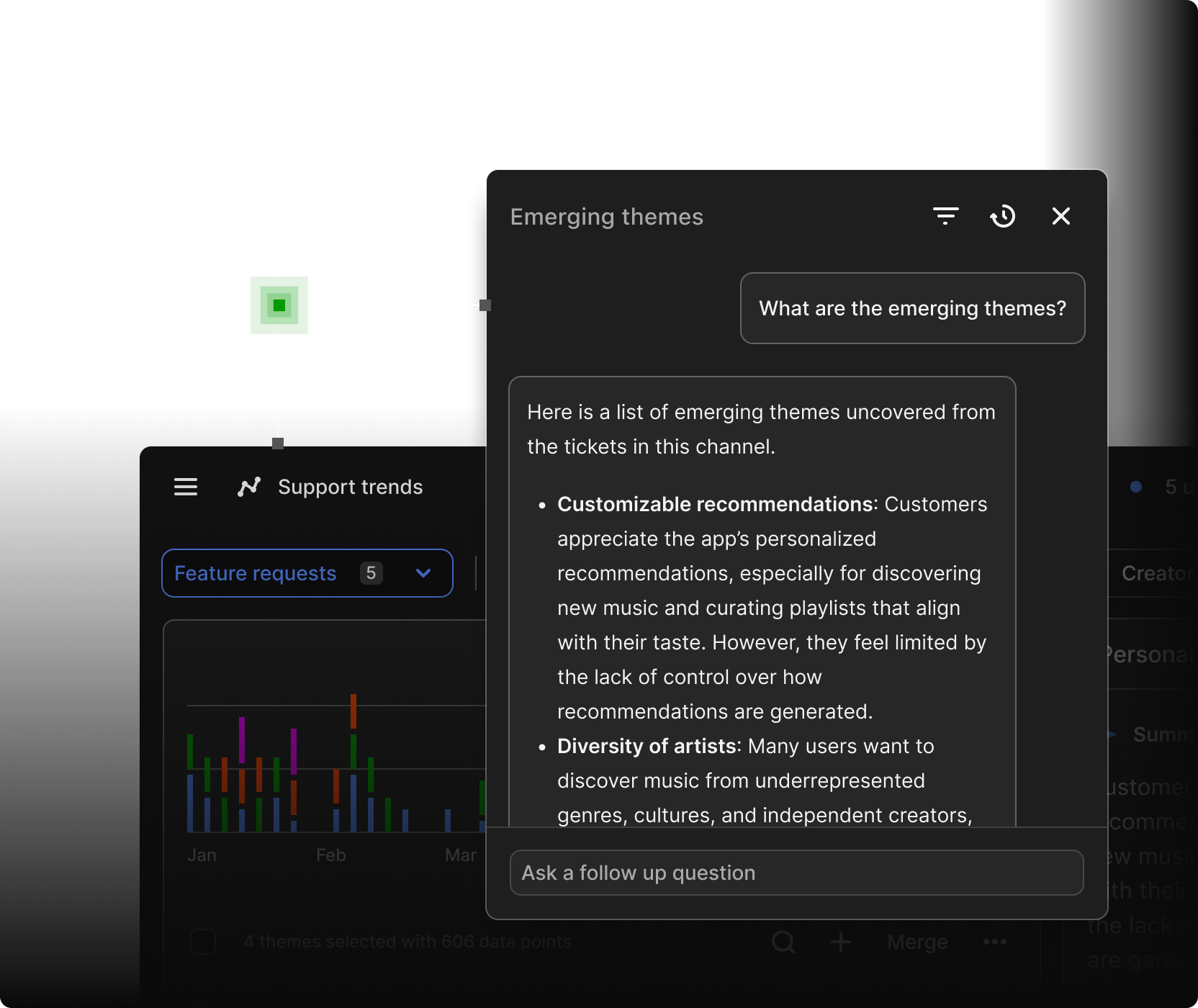
The payoff: product managers querying the workspace directly, without waiting for a research request
The measure of the platform is not how productively the research team uses it. It's how far the intelligence travels.
At this firm, the answer is increasingly: across the organization. Designers who never trained as researchers are uploading interview recordings, letting AI analysis surface the themes, and sharing findings that colleagues in other practice areas can actually find. Product managers are querying the workspace directly, asking questions about internal user behavior without waiting for a research request to be scoped and staffed. Consultants are drawing from a living repository of organizational knowledge that grows richer with every project added.
The research team's ambition is straightforward: there is already a substantial body of work in Dovetail. The goal is to make sure that value stays in Dovetail, rather than leaking into bespoke tools, one-off reports, or slide decks that no one revisits. That is a shift in how a 50,000-person organization treats its own knowledge, from a byproduct of individual work to a shared strategic asset.
The Customer Intelligence Platform that makes this possible is not only for market-facing research. The same infrastructure—centralized data, AI-powered synthesis, self-serve querying—works just as powerfully when the customer is your own workforce. This firm is building the proof, one compounding insight at a time.

The best [] never guess
Discover how Dovetail can help your team turn customer feedback into decisions.


FAQs
Yes. One of our customers embedded its internal vocabulary directly into its Dovetail workspace’s custom context, so Chat understands the organization’s own language the moment someone opens a query instead of returning generic answers.
A set of foundational interviews uploaded by one researcher years earlier at one of our customers was later accessed and built on by at least five other researchers working on related problems, saving each of them hours they’d have otherwise spent redoing the original work.
When a single observational study at one of our customers generated 500 or more data points, the research team built a shared template library, naming conventions, and firm-specific tag taxonomies directly into their Dovetail workspace, turning organically organized sprawl into research any practitioner could find and build on.
Yes. Designers who never trained as researchers at one of our customers now upload interview recordings and let AI Analysis surface the themes, while product managers query the Dovetail workspace directly to answer questions about internal user behavior without waiting for a research request to be scoped and staffed.
Yes. One of our customers built an internal Dovetail community of 300-plus practitioners across research, design, and consulting, running quarterly training sessions, including one that drew more than 75 registrants in late 2025, to shift the culture from “I have research” to “we have research.”