Engineers, you're not the first to panic about democratization

Some engineers are throwing a tantrum about democratized code. But UXRs went through this exact crisis years ago. Here's what they learned so you don't have to.
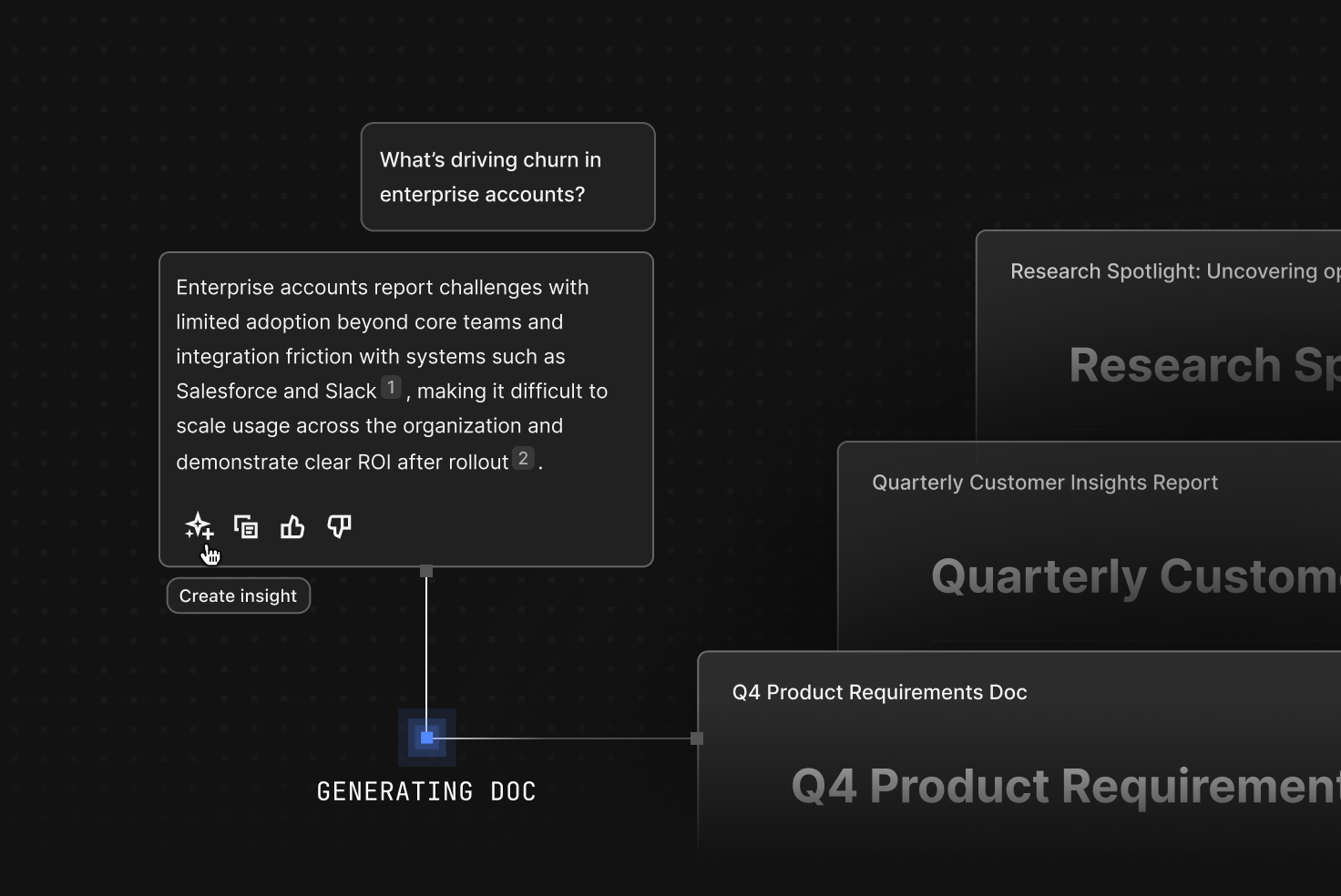
When AI research tools started transcribing interviews, clustering themes, and surfacing insights automatically, UX researchers had a very public moment of professional anxiety. Suddenly, anyone with a Zoom recording and a prompt could approximate synthesis that used to take weeks. The response from parts of the research community was swift and familiar: this data isn't rigorous. The methodology is wrong. Someone is going to make a terrible product decision based on garbage input.
Engineers are now having the same moment, almost beat for beat. AI coding tools and agentic systems are putting the ability to write software into the hands of PMs, designers, and founders who've never touched a codebase. And the engineering community's response? This code isn't production-grade. The architecture is wrong. Someone is going to ship something that breaks everything.
Both groups are raising real concerns. The problem is what they do with them.
The quality problem is genuine, and it cuts both ways
UXRs were right to worry about research quality. A poorly designed survey poisons every insight that flows from it. Leading questions produce confirmation bias dressed up as evidence. A sample of 12 self-selected users tells you almost nothing about a market. When non-researchers run studies without methodology guardrails, the outputs look like intelligence but function like noise. And that noise feeds directly into product decisions, roadmaps, and resource allocation.
Engineers face an equivalent problem with democratized code. A vibe-coded internal tool can look functional on the surface while quietly accumulating security vulnerabilities, carrying no error handling, scaling to exactly zero under load, and generating technical debt that compounds every week it stays in production. The architecture decisions that seem invisible at day one become catastrophic at month six. Bad code, like bad research, looks fine until the stakes get high enough to reveal it.
The parallel runs deeper than it first appears. Both research data and code are infrastructure. They're the foundation on which consequential decisions and systems get built. Quality failures in either don't announce themselves immediately. They surface downstream, when the cost to fix them is orders of magnitude higher than it would've been to catch them early.
When things break, specialists still get the call
Here's the other concern engineers are raising, and again, UXRs know this feeling well: when a non-specialist does the work and something goes wrong, the specialist gets handed the wreckage.
A product team runs a research study without a UXR. The questions are leading, the participant pool is skewed, and the synthesis is a mess of confirmation bias. Months (or weeks) later, a product ships to a resounding non-response from customers. The UXR gets called in to figure out what went wrong. They spend weeks untangling research that was never sound to begin with, and rebuilding the understanding the team thought they already had.
The engineering version of this is already playing out. A PM builds a quick internal tool with an AI coding assistant. It works, until it doesn't. The database queries are unindexed. There's no authentication. A minor load spike takes it offline. The engineer gets paged at 11pm to fix code they never wrote, in a system they've never seen, with no documentation and no tests.
Both of these are legitimate grievances. Democratization without standards creates cleanup work, and that cleanup disproportionately falls on the specialists who understand the craft well enough to fix it.
The role has already changed, whether you accept it or not
UXRs who thrived through this period figured out something important: the job didn't get smaller, it got different. The researcher who spent 100 percent of their time conducting studies shifted into a hybrid role. Part of the work became doing the high-complexity, high-stakes research that genuinely requires deep expertise: longitudinal studies, sensitive populations, strategic synthesis that shapes company direction. The other part became enabling others to generate reliable signal without creating methodological disasters—building research standards, training cross-functional partners, designing templates and guardrails that make self-serve research trustworthy.
The specialist didn't disappear. The specialist became the standard-setter, the quality bar, and the escalation point for work that actually mattered. Their influence expanded because they stopped treating access to research as the source of their value, and started treating their judgment as the source of it.
Engineers are heading into the same transition. The ones who come out ahead will be the ones who define what "good" looks like for AI-generated code in their organizations: the architecture principles, the security baselines, the review processes that catch the problems vibe-coding reliably introduces. They'll handle the system design decisions that no AI can make well, because those decisions require understanding the business context, the trade-offs, and the consequences in ways that take years to develop.
The role is shifting from sole executor to enabler and expert in the same motion. That's a harder job in some ways, and a more leveraged one in every way that matters.
What UXRs would tell engineers if they were in the room
Stop trying to keep the tools out of other people's hands. You won't win that fight, and winning it wouldn't serve anyone well anyway.
Build the standards that make democratization safe. Write the guidelines. Design the review processes. Define the criteria for when something needs expert involvement versus when a self-serve approach is good enough. Make your expertise legible to the people working around you.
Treat quality as a shared responsibility, not a professional secret. The UXRs who created research enablement programs—who trained PMs to run solid generative interviews, who built templates that encoded methodological rigor into the process—ended up with more influence over product direction than the ones who stayed protective of their methods.
The specialists who made themselves indispensable weren't the ones who controlled access. They were the ones who raised the floor for everyone else, and reserved their deepest expertise for the work that actually required it.
Engineers who figure that out now will find themselves better positioned than they expect. The ones who don't will discover that being the only person who can write code, is a less durable advantage than it used to be.
Related Articles