Your research is good. So why isn't it changing anything?
You did the research. You ran the interviews, synthesized the findings, and wrote a clear report. Then… nothing changed. That's not a quality problem. It's a distribution problem.
It’s one of the most disorienting experiences for a researcher. The work was rigorous. The findings were clear. And yet the decisions moved on without them.
Here’s the hard truth: good research doesn’t automatically drive decisions. Insights only matter when they’re believed, understood, and acted on—and that’s a much harder bar to clear than producing a well-written report.
The report is not the finish line
Most researchers are trained to think of a delivered report as the end of a project. But delivery is really the beginning of a different kind of work: getting your findings into the room where decisions happen.
The gap between “research complete” and “research used” is where impact dies. Stakeholders are busy. They have their own priorities, their own data sources, and their own mental models of what customers want. A PDF in a shared drive—however thorough—doesn’t compete with a strongly held opinion in a planning meeting. Yet the researcher who ran the study is rarely in the room when the roadmap gets set.
Trust is the currency of influence
Before your research can change anything, the people who need to act on it have to believe it. That sounds obvious, but it’s worth sitting with: insights only drive decisions when the underlying data and interpretation are trusted.
Trust breaks down in predictable ways. Findings from a single study feel fragile. Qualitative data gets dismissed as “just a few interviews.” Research that contradicts existing assumptions gets labeled as “interesting but not representative.”
Visibility is the antidote. When stakeholders can see where an insight came from, trace it back to real customer voices, and understand the reasoning behind the interpretation, the credibility of the work goes up. Findings that can be cross-referenced across multiple studies, over time, carry far more weight than findings from a single project.
A shared repository is an organizational convenience, yes, but it’s also an influence strategy. When your research lives in one searchable place, patterns accumulate. The fifth time a stakeholder sees the same customer pain point surfaced across different studies, it stops being a one-off finding and starts being an undeniable signal.
The richest signals often live outside the research team
One of the most persistent gaps in how organizations use research is the separation between formal research and the informal intelligence that flows through the rest of the business every day.
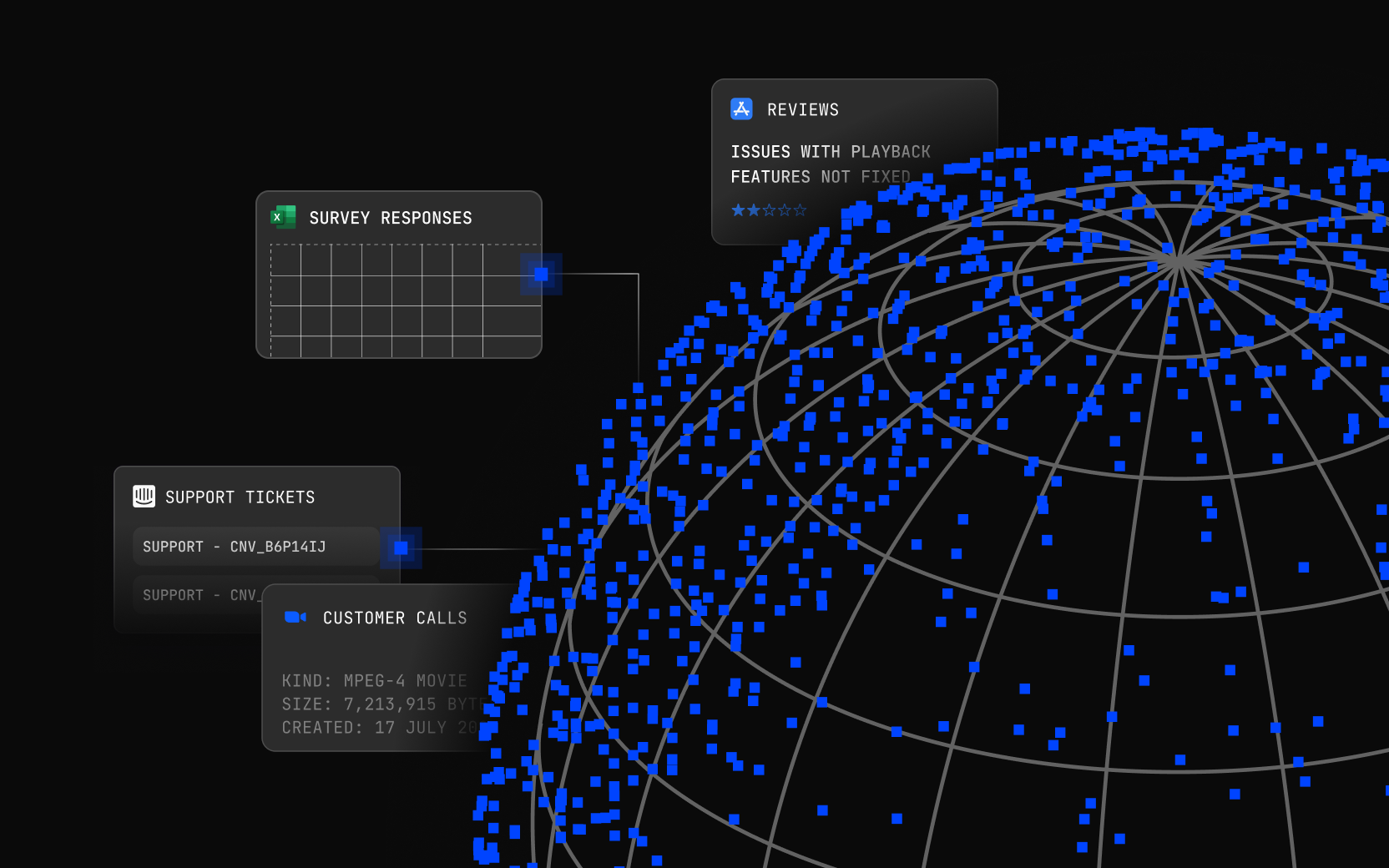
Support tickets, sales calls, NPS responses, community posts—these are all customer signal. They’re often noisier and less structured than what comes out of a usability study, but they’re also continuous and high-volume. They capture what customers do when no one’s watching, not just what they say when asked.
Researchers who learn to connect their findings to these adjacent signals become much harder to ignore. When your usability findings match a spike in support tickets around the same workflow, you’re presenting a convergent picture that multiple teams already have partial visibility into.
This kind of connection-making doesn’t require doing more research. It requires pulling in more signal. And increasingly, platforms that centralize customer intelligence across sources make this possible without a researcher having to manually stitch together data from a dozen different tools.
“Acting on research” is not one thing
When researchers talk about wanting their work to have impact, they usually mean they want it to change something—a roadmap decision, a feature direction, a product strategy. But acting on research isn’t a single moment. It’s a spectrum.
Sometimes acting on research means a PM investigates a finding more deeply before raising it at planning. Sometimes it means an engineer checks the repository before starting work on a flow users have flagged as confusing. Sometimes it means a designer references a highlight reel in a design review to justify a direction.
None of these feel like “big impact” from the outside. But they compound. Research that gets referenced regularly—even informally—shapes the decisions that accumulate into a product’s direction.
The implication for researchers is that influence often happens through adjacency rather than direct advocacy. Making research easy to find, easy to quote, and easy to share matters as much as making it rigorous. A well-organized insight that a PM can drop into a Slack message at the right moment can do more for your impact than a polished deck that requires scheduling a meeting.
The organizational barriers are real—but they’re not permanent
In many organizations, research still operates as a gate rather than a resource. Research is something you commission, wait for, and then receive as a formal deliverable. The teams who produce it often control who can see it, how it’s interpreted, and what it’s used for.
This model made sense when research was slow and expensive. It makes less sense when teams need to move fast and customer signals are available continuously. The organizations that are shifting fastest to a more research-influenced culture are the ones where insights are accessible to everyone who needs to make decisions.
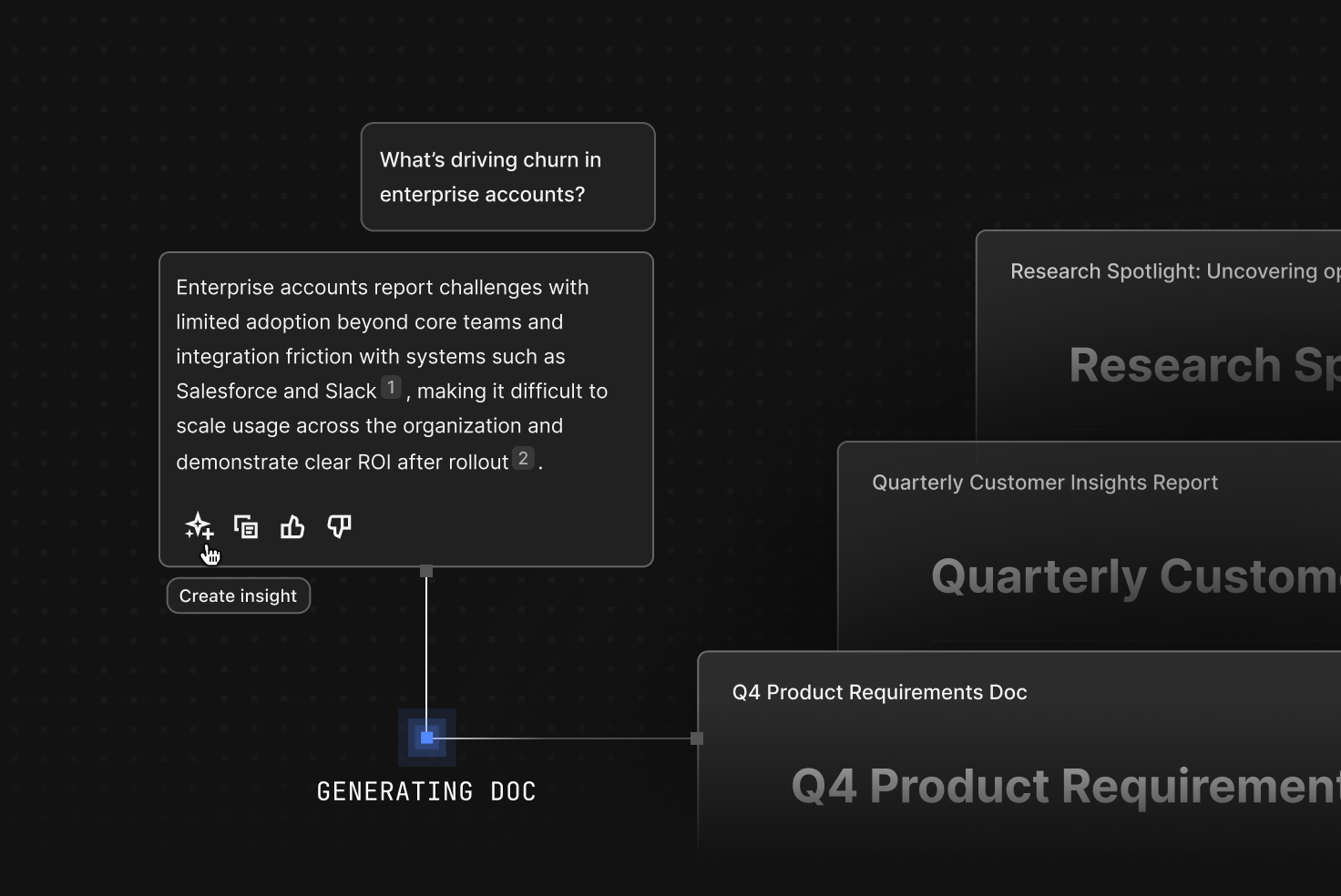
That shift requires researchers to do something counterintuitive: give up some control in order to gain more influence. When stakeholders can self-serve insights—search the repository, watch a highlight reel, ask a question and get an answer grounded in actual customer data—they become more connected to customer reality. And researchers become the architects of that intelligence layer.
What actually changes things
The researchers with the most organizational impact aren’t necessarily doing better research than their peers. They’re doing better distribution.
They share findings in the channels where decisions are made. They connect insights to the metrics stakeholders already care about. They build a repository that accumulates value over time, so research from six months ago is still findable and citable when a relevant decision comes up. They make it easy for non-researchers to engage with customer data without needing a guided tour.
And critically—they measure their impact not by whether people attended a research presentation, but by whether the research showed up in a decision.
The goal is to build a system where customer intelligence is the default input to decisions across the organization.
Your research is good. The question is whether it’s working hard enough after you’ve done it.
Related Articles