
CUSTOMER / A MODERN BANKING PLATFORM FOR AMBITIOUS BUSINESSES
How a banking platform turned fragmented feedback into company-wide customer intelligence
For a financial platform trusted by tens of thousands of businesses, customer feedback used to stop at the edges of each team. Now it reaches the executive suite—and the CEO is calling their quarterly voice of customer meeting ‘the best one yet.’

35,000+
monthly support tickets now surfaced to cross-functional teams
5
teams now sharing the same customer intelligence
56,000+
data points processed in the first six weeks of Channels
The best never guess
Discover how Dovetail can help your team turn customer feedback into decisions.
Built for customer closeness—at the scale of tens of thousands of businesses
This financial platform exists to give businesses the banking infrastructure they need to grow: bank accounts, cards, and payment infrastructure for businesses of every size and stage. For their customers, the product has to be near-flawless. The smallest friction point can shake a founder’s confidence—and the gap between staying and churning is often a detail the product team never knew about.
Customer-centricity has always been central to how this company operates. “It’s been very important that the product team stay close to the customers,” says a senior member of the design team. But at the scale of tens of thousands of business customers, being close isn’t just a cultural value—it’s an operational challenge.
The company had already invested in Dovetail for its research and design teams. What they needed wasn’t just a repository for user interviews. They needed a true customer intelligence platform: a system that could turn every signal the company received—35,000 monthly support tickets, Gong call transcripts, product feedback from account managers, surveys from product marketing—into insights the whole organization could act on.

The challenge: four teams, four silos, and a quarterly meeting that couldn’t keep up
Before expanding their use of Dovetail, the company’s voice of customer process ran once per quarter—and skewed almost entirely toward what the revenue team was hearing. The support team was fielding roughly 35,000 Zendesk tickets every month, but those insights rarely reached product teams in any structured way. Revenue was logging call data in Gong and capturing product feedback in Salesforce. Product marketing was running surveys and storing readouts in Google Slides. Research was doing user interviews in Dovetail.
Every team was generating signal. None of it was connected.
Assembling the quarterly VOC meeting required significant manual effort—someone had to pull each source, summarize by hand, and present to a room of cross-functional leaders. The picture that emerged was partial: weighted toward the revenue pipeline, with almost nothing from the support team who spoke to customers every single day.
There was also a subtler problem. A feature request from 20 small accounts and the same request from five of the company’s largest depositors carried the same apparent weight. For a banking platform where gross profit and deposit size vary dramatically across customers, that distinction matters enormously.
“Not all feedback is equal. Twenty requests from small accounts don’t automatically outweigh five from your largest depositors. Now we can actually see which signal carries more weight.”
— Head of Account Management
The solution: one workspace connecting support, revenue, product, and marketing
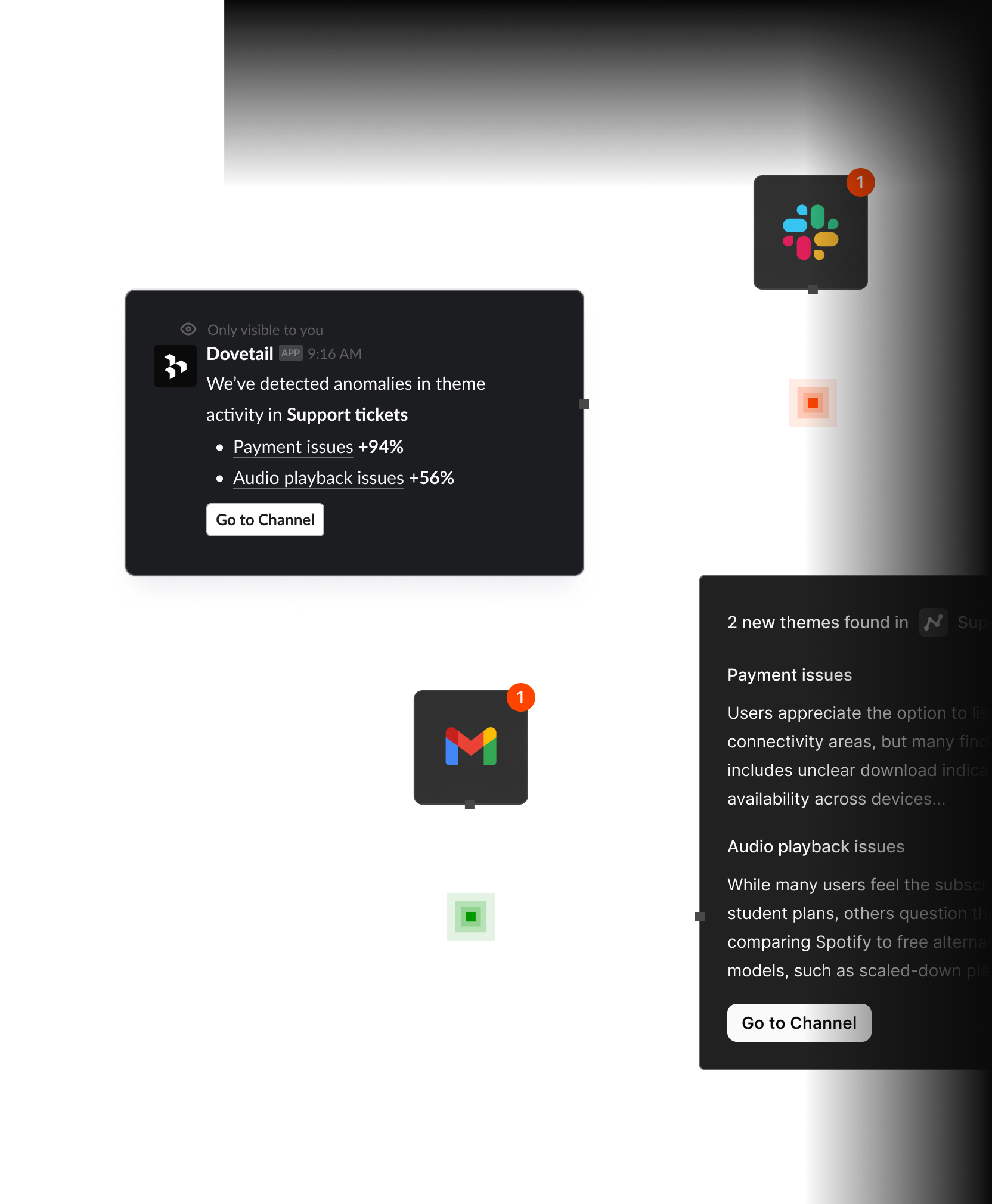
The expansion began with a question from the product operations team: what would it take to synthesize all of this into something the whole organization could use? The answer was Dovetail Channels—a way to ingest high-volume feedback from multiple sources and surface trends automatically, organized around the product teams that needed to act on them.
They connected Zendesk first, given the volume of incoming support tickets. Then came a Salesforce export uploaded as a CSV, bringing revenue feedback into the same environment. The structure they built in Dovetail mirrored the company’s product organization: dedicated channel topics for each of their ten-plus product groups, shaped around the questions those teams were actually trying to answer. When a new initiative was about to ship, teams created theme trackers in advance—primed to capture customer response as it arrived.
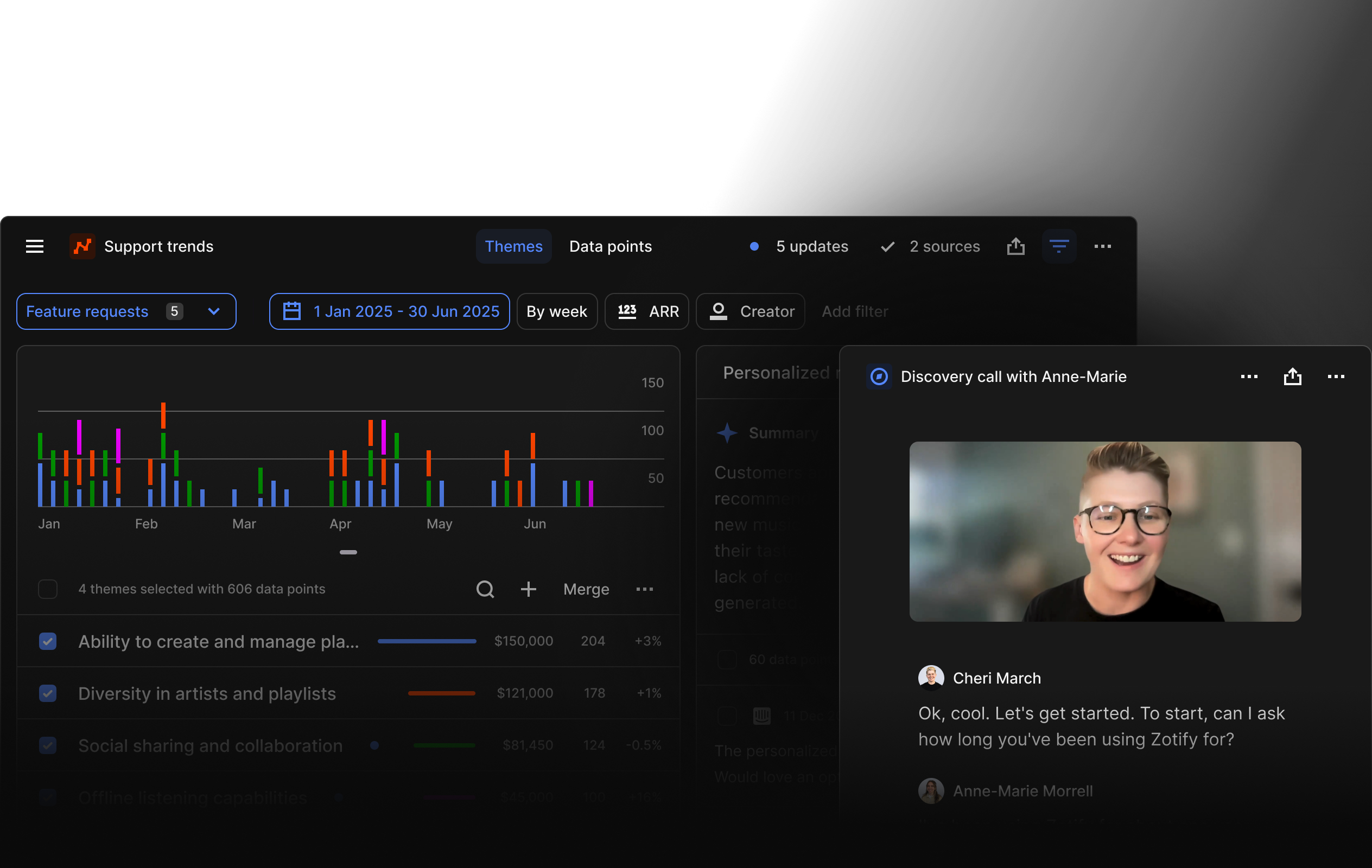
But the bigger shift was who was now in the room. For the first time, the head of account management, the head of customer support, and the product marketing team were working alongside the research and design teams—not in adjacent tools, but in the same Dovetail workspace. Feedback from Zendesk tickets, Gong transcripts, and Salesforce field notes could be analyzed side by side, filtered by customer segment and deposit size, and surfaced as AI-generated themes for each product group.
“Channels has made a real difference to how we work as an organization.”
— Product Operations Lead
The outcome: customer intelligence that reaches the executive table
The impact became clear at the next quarterly VOC meeting. The product operations team had structured Dovetail Channels around the ten product groups that typically participated. The head of customer support and the head of account management had both contributed their data. The result—a synthesized, cross-functional view of what customers were actually saying—landed differently than any previous meeting.
“The CEO called it the best quarterly VOC meeting we’d ever run,” says the Product Operations Lead. “Channels played a big part in that—pulling in support insights had always been a real gap before.”
That reaction from the executive team prompted a bigger conversation. If a more complete picture could make the quarterly meeting feel like a step change, what would it mean to run this more frequently? The CEO requested a move from quarterly readouts to a monthly program—one where product managers, support leads, and revenue teams could self-serve the customer intelligence they needed, rather than waiting for a manual compilation every three months. Semi-annual product planning cycles could now draw on a living, continuously updated picture of what customers were saying, weighted by the revenue context that made each signal meaningful.
Fifty-six thousand data points processed in the first six weeks alone. What began as a research tool for one team is now Dovetail operating as the shared intelligence layer for five cross-functional teams—the single place every product manager, support lead, and revenue team goes to understand what customers actually need. For the first time, that understanding reaches the executive table as fast as it reaches the people who generate it.

The best [] never guess
Discover how Dovetail can help your team turn customer feedback into decisions.






FAQs
Yes. One of our customers connected a support ticketing tool (Zendesk) first, given its ticket volume, then added a CRM export (Salesforce) of revenue feedback, organizing both inside Dovetail Channels around each of its ten-plus product groups so every team could see trends surfacing from support tickets and sales calls alongside interviews.
Yes. Feedback can be filtered by customer segment and account value, so a handful of requests from a company’s largest accounts isn’t automatically outweighed by a larger volume of requests from its smallest ones.
Yes. For one of our customers, the heads of customer support and account management, plus the product marketing team, began working alongside research and design inside the same Dovetail workspace, analyzing support tickets, sales call transcripts, and CRM notes side by side instead of in adjacent tools.
For one of our customers, Channels processed more than 56,000 data points in its first six weeks of use, drawing on support tickets, sales call transcripts, and CRM notes submitted from across the business.
Yes. After Channels replaced a manual, quarterly voice-of-customer compilation with a structured, cross-functional view, one customer’s CEO called the resulting meeting the best quarterly VOC meeting the team had ever run, and asked to move the whole program from quarterly to monthly self-serve reporting.