What a fragmented VoC program can cost you
.png)
Fragmentation doesn't just scatter data, it actively degrades the signal. The more sources you add without a shared layer to connect them, the less any single team can trust what they're seeing.
Ask most teams how customer feedback flows through their organization, and you'll hear some variation of the same answer: "It's a bit all over the place."
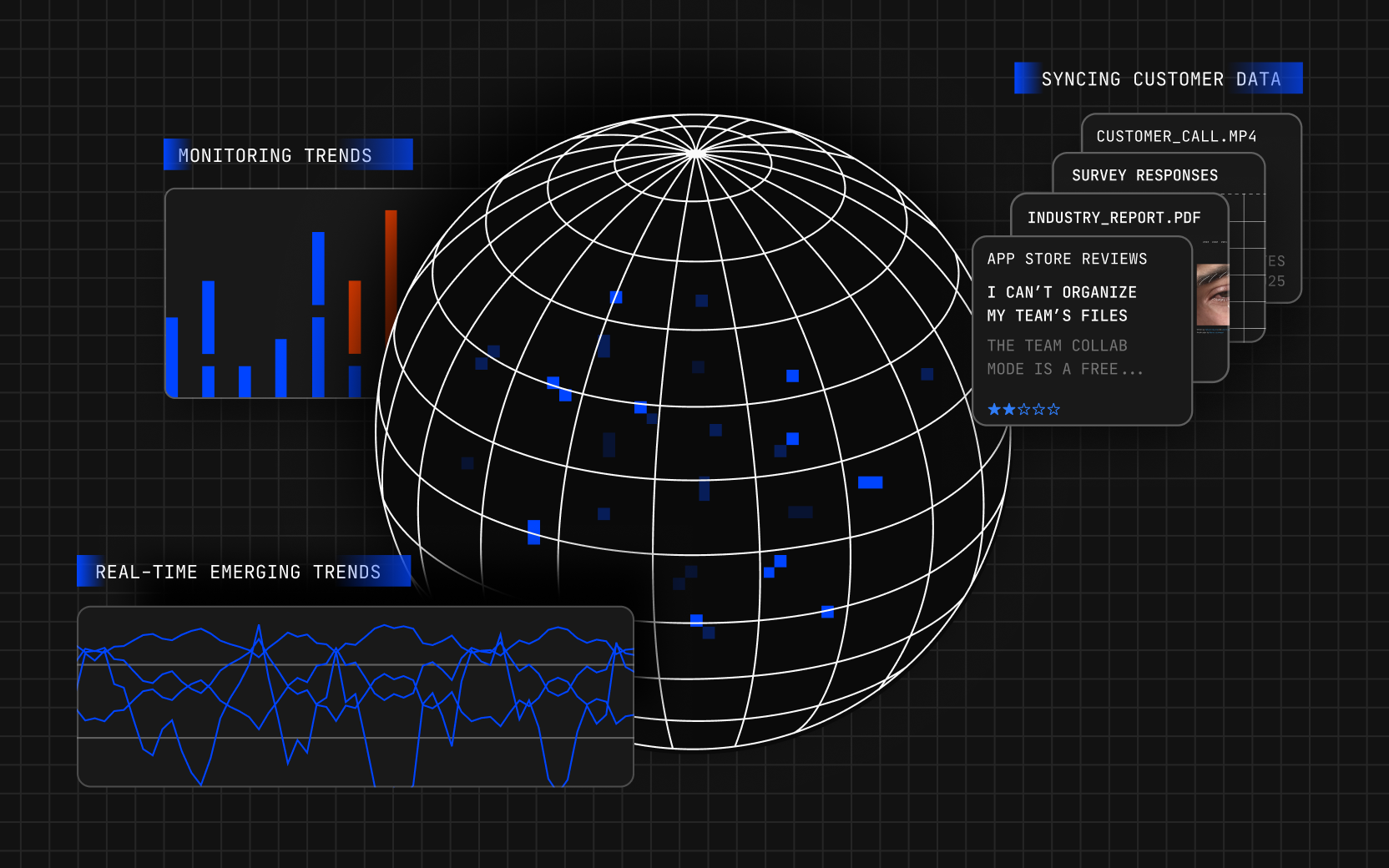
One enterprise running feedback across Qualtrics, Zendesk, app stores, NPS surveys, support tickets, and chat described the situation plainly: reports are built manually in Excel, sent out in isolation by their team, so open-ended responses go unread, and there's no way to track themes over time or surface what's actually trending. The effort put into collecting feedback was real but the architecture to connect it isn't there.
At one large telehealth provider, the product operations team was spending over 20 hours a month manually processing feedback from Qualtrics NPS data alone, before even looking at app store reviews or call center data. "A lot of the analysis has been done kind of in silos or very manually," one researcher noted. Their goal was clear—"across all of these data sources, here are key opportunities or pain points that we should be working to address as an organization"—but between that goal and the current reality sat five separate systems with no shared layer.
Why it stays invisible
The fragmentation problem is hard to see because the work still gets done and insights still get shared. But quietly, it spreads across dozens of small inefficiencies that nobody can add up.
When a senior product manager (PM) at a major technology company was actively running an internal project to consolidate nine feedback systems, they still hadn’t fully named it as a strategic problem: “We don’t have a single way to look at all of our data and insights in one place.” Another Director of Design at a fast-growing tech company described multi-tools and team fragmentation as simply “the reality”, because when fragmentation is the baseline, nobody escalates it and nobody owns fixing it.

What it looks like in practice
At one European energy and telecom company, feedback was scattered across at least two separate ticket systems for email alone, and the PM responsible for it wasn't entirely sure where everything came in. "It is quite fragmented... I'm not entirely sure where everything comes in in those channels either."
At one software company, entire product prioritization was done manually in Excel, pulling from Zendesk, Gong, Slack, and email. Someone spent hours each week stitching together a picture that was already out of date by the time it was shared—no centralized layer, no automated synthesis.
At one major airline, a team member was running eight manual reports every month, each siloed to Qualtrics and Glassbox (a digital experience analytics platform), and each requiring manual assembly before it could reach anyone who needed it.
At one SaaS company, a PM recounted the feedback environment as a "sausage factory"—Intercom, a Slack feedback channel, Wingman, AirCall—"a whole bunch of feedback just coming into the machine that you're trying to make sense of." Something goes in. Something comes out. What happens in the middle is opaque.
Another operations team described it with the kind of weary specificity that only comes from living it: "We're currently in an environment where we have a lot of data scattered across various different touchpoints and locations—Slack, emails, Jira, Salesforce, sales and customer call recordings. We want to be able to synthesize all of this into one central database, and then extract the right insights and reports that can serve many different stakeholders."

What fragmentation actually costs
Adding more tools for the sake of more tools only creates further fragmentation, and this fragmentation cost continues to compound.
The loudest voice wins. When there's no authoritative, cross-channel picture of what customers are saying, decisions default to whoever is most vocal in the room—the sales rep with a loud account, the executive who just came back from a conference, the customer who emailed the CEO. It isn't intentional. It's what happens when the data that would contradict those voices is locked in a tool nobody checks.
Research gets repeated. At one company, the same study was conducted three times in one year because nobody knew it had already been done. At another, the Director of Design described research falling into "ad hoc" use because "the repository right now reflects studies that were done months, if not years ago."
Insights enter a graveyard. A PM at one organization described the standard lifecycle: insights get shared in a meeting, circulated in Slack, maybe written up in a doc—then "back in the box in the closet and enters that void of I don't know if it exists." At one large enterprise software company, insights sat in an internal wiki discoverable only by word of mouth. "The repository was rarely the solution. It was, go ask this certain person instead." The institutional knowledge lives in people rather than systems.

Customers feel it too. The most consistent shortcoming of fragmented VoC programs is the feedback black hole—customers share something and never see any sign it was heard.
"One of the biggest shortcomings of any VoC collection program is people feeling like what they're sharing is going into a black hole, and they don't actually have a voice." —Director of Customer Success at an HR technology company
The architecture problem beneath the process problem
The problem is structural. A product leader can't tell you what their top customers are saying without pulling data from five different systems, and when the typical enterprise CX survey reaches only 7% of customers, what's sitting in those five systems is only partial signal. A designer can't tell you whether a problem they're solving has already been researched. A CS manager can't prep for a renewal without manually stitching together support tickets, call notes, and NPS scores from separate platforms. These aren't process gaps—they're the predictable output of an architecture where every team runs their own data stack with no shared layer between them.
What fixing it actually requires
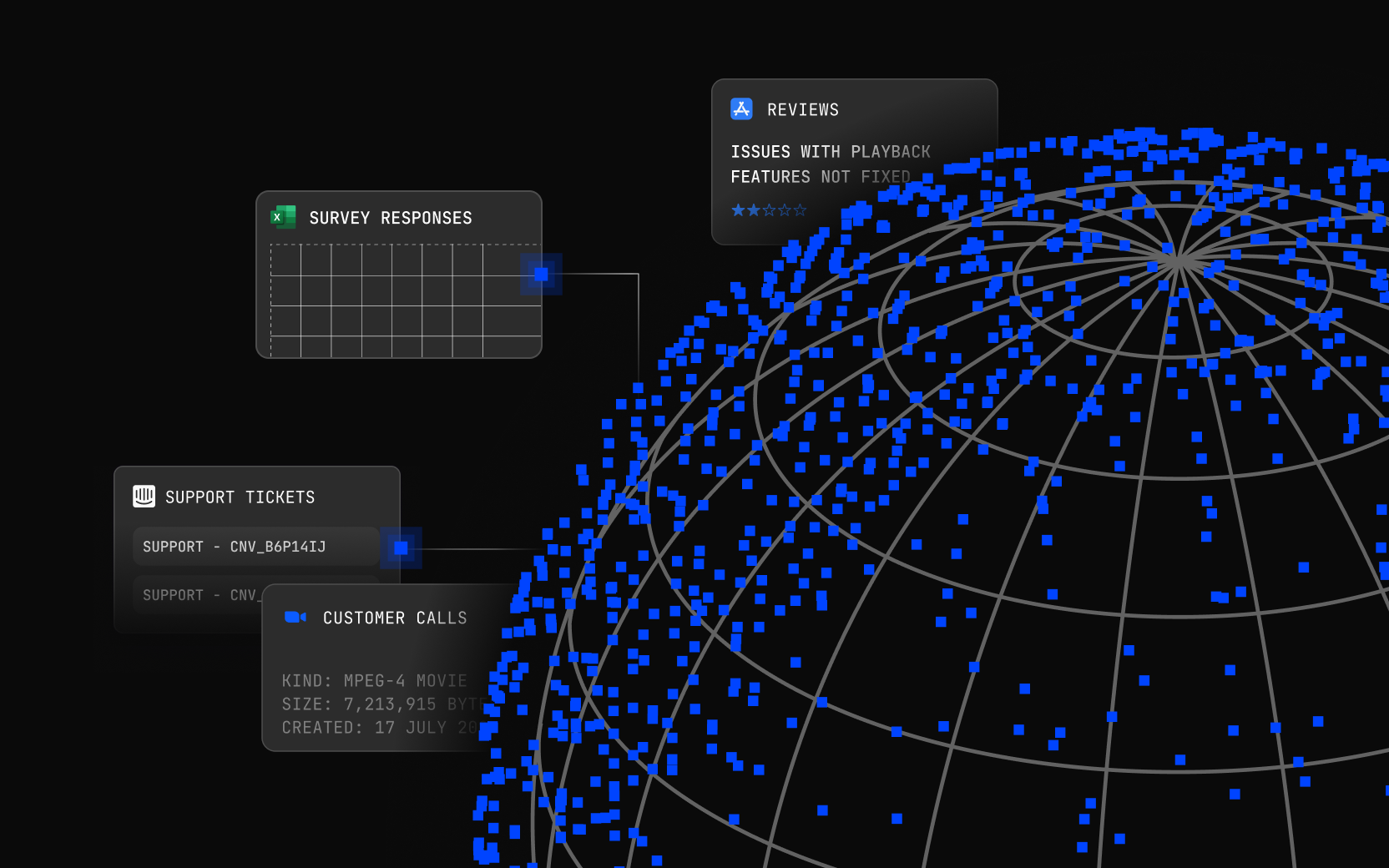
Centralizing feedback means building a shared layer above the tools teams already use—one that continuously ingests from Zendesk, Gong, Qualtrics, Intercom, app stores, wherever signal is generated, and synthesizes it in a way that every team can actually access.
The teams that have built this describe the shift as transformational. At one global industrial technology company, a product team went from never mentioning customers in prioritization meetings to having customer data appear in every decision, filtering up two levels to senior leadership. "We've gone from never talking about customers to now in every prioritization conversation, in every justification conversation," said a solutions manager there.
At one healthcare technology company, the goal was explicit from the start: a single source of truth where all customer interactions come in, giving everyone in the company a place to understand customers and make decisions with voice of customer at the center. The blocker was feedback fragmented across different tools and teams, with information that "just lives in our heads."
The companies that get this right aren't necessarily the ones with the most sophisticated processes. They're the ones that stopped treating tool fragmentation as a normal cost of doing business, named it as an architecture problem, and built the layer that connects the pieces.
Your customers are talking to you across ten channels. Are you hearing them?
Related Articles