
CUSTOMER / ONE OF THE WORLD'S MOST ICONIC AUTOMAKERS
How one of the world's most iconic automakers put customer intelligence in the hands of its engineers
Across a global automotive manufacturer with over 170,000 employees, customer research used to be duplicated across teams and invisible to engineers. Today, product managers, engineers, and designers across multiple business units self-serve customer intelligence without waiting for a researcher.

48+
UX and CX professionals accessing shared customer insights in one business unit alone
4+
teams across digital design, e-commerce, and financial services on one platform
2 weeks
cut from insight delivery—designers and engineers now act on research findings before the formal report is written
The best never guess
Discover how Dovetail can help your team turn customer feedback into decisions.
A global manufacturer with millions of customers yet a fragmented view of them
One of the world's most recognizable automakers is also one of the most digitally ambitious. With over 170,000 employees and a website visited by millions of buyers every single day, this manufacturer has built a direct digital relationship with its customers, including the ability to purchase electric vehicles entirely online without stepping into a dealership. Dedicated teams of product designers, UX researchers, engineers, and digital strategists power that experience across multiple business units.
For a company operating at this scale, grounding every product decision in what customers actually say is an organizational challenge, not just a research one. Customer knowledge was being generated constantly, across usability labs, digital sessions, support channels, and customer interviews. The problem wasn't a shortage of feedback. It was that the feedback was scattered, siloed, and largely invisible to the engineers and product managers who decide what to build next.
That fragmentation is what led them to Dovetail. It started with one digital team, spread through internal referral to a global design unit, then to e-commerce, then to financial services. Team by team, the company built out a Customer Intelligence Platform that now connects hundreds of people across business units to the same customer knowledge base.

The challenge: research duplicated across teams, invisible to the engineers shipping products
Before Dovetail, customer knowledge lived in individual inboxes, shared drives, and the personal notes of whoever ran a given study. Teams in different business units would independently run research on the same feature, generating overlapping findings that neither group could see.
The lead UX strategist for one of the company's financial services divisions describes the problem clearly. Her team of nearly 50 UX and CX professionals was generating real customer insight, but it wasn't reaching the people who could act on it.
"We have all these different sources of feedback, and the problem is everything lives in a silo. We realized we were doing research about the same feature, and another person was doing exactly the same. Now with one place for all these insights, you can go there, self-serve the data, and avoid duplicating efforts."
— Lead UX Strategist
Product managers, under pressure to ship, defaulted to instinct. Engineers received research findings secondhand, filtered through presentation layers. Customer research happened in one corner of the organization while product decisions happened in another. The lead UX strategist put it plainly: "It's not just the product manager who knows what customers need. You need to ask them, and then build the solution from that feedback."

The solution: a searchable hub that engineers and product managers access directly
The company's Dovetail adoption spread through internal referral. When the global experience design team's leader learned how a separate digital unit was already using the platform, she moved her ten-person team onto it immediately. Team members had independently identified Dovetail as their research repository of choice. Because the platform was already an approved vendor across the organization, expansion was fast. Adoption grew to cover e-commerce and financial services divisions.
Each team now stores research sessions, builds searchable insight repositories, and shares findings across functions. On the vehicle e-commerce team, designers watch session recordings in Dovetail as usability tests conclude, identifying critical issues and flagging them to engineers before the formal synthesis report is even written. The team runs quarterly end-to-end usability tests on its live EV e-commerce experience, with every session uploaded and available across the organization.
The lead UX strategist frames the shift in terms of organizational access:
"We want to get all of the organization closer to the customer. The way to do that is not just collecting feedback, but making it available for all of our product organization, our engineers, so they can go and self-serve insight about their products."
— Lead UX Strategist
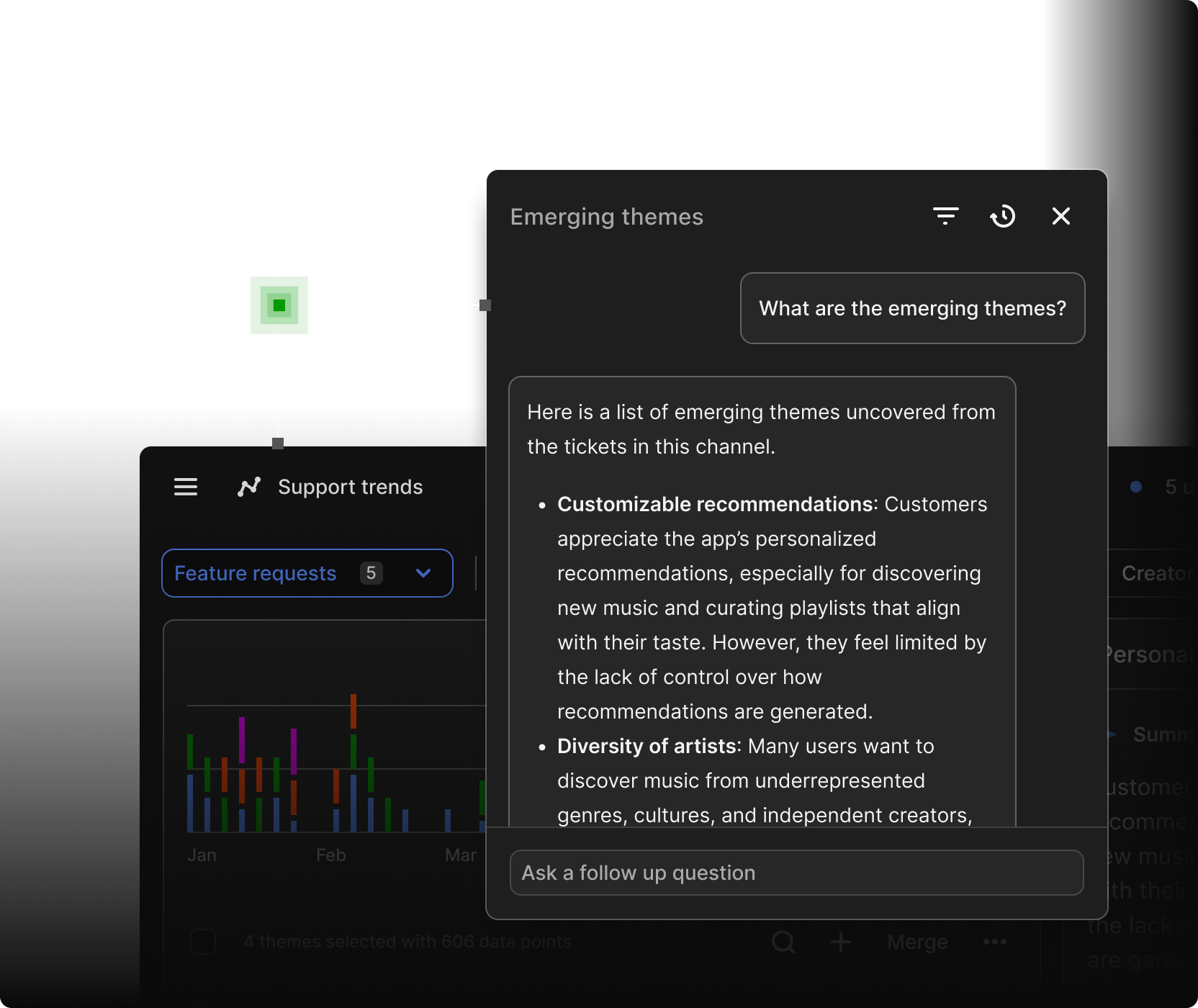
Teams also use Dovetail's Chat to surface cross-project intelligence on demand, letting stakeholders query the full customer knowledge base and get cited answers without asking a researcher to dig through multiple project archives.
The payoff: engineers self-serving customer knowledge, and agency partners calling it "gold"
The impact became visible fastest when people outside the research team encountered the platform for the first time. The head of UX research describes the moment an agency partner was given access to the hub:
"Once they got a hold of it, the agency partner was like, 'We have nothing like this. This is gold. This is what I need.'"
— Head of UX Research
Engineers who previously relied on secondhand summaries can now query customer intelligence directly. Product managers access the same evidence the research team uses. The head of UX research describes how the organization is beginning to treat Dovetail as the source of truth for what the company knows about its customers, tracking how many engineers and product managers go there, which studies they find, and whether those findings surface in product decisions.
Within months of launch, the research team set a target of 250 active users across the organization, a signal of how quickly the appetite for customer intelligence had outgrown the research team's capacity to distribute it by hand.
The goal wasn't more research. It was better access to the research that already existed. That's exactly what Dovetail delivered. Now, the best teams at one of the world's most iconic automakers don't have to guess.

The best [] never guess
Discover how Dovetail can help your team turn customer feedback into decisions.






FAQs
Yes. For one of our customers, different teams were independently researching the same feature until a shared workspace let them self-serve existing insights instead of duplicating the work. As that customer’s lead UX strategist put it, teams can now go to one place and “avoid duplicating efforts.”
Yes. On one customer’s e-commerce team, designers watch session recordings in Dovetail as usability tests wrap up and flag critical issues to engineers before the formal synthesis report is even written, cutting two weeks from insight delivery.
Yes. Teams at one of our customers use Dovetail’s Chat to query the full customer knowledge base and get a cited answer on demand, without asking a researcher to search through multiple project archives.
Yes. Adoption at one of our customers spread by internal referral—from a single digital team, to global design, to e-commerce, to financial services—until four business-unit teams shared one customer knowledge base. One division alone counts nearly 50 UX and CX professionals now working from the same insights.
One of our customers’ research team set a target of 250 active users across the organization within months of launch. It now tracks how many engineers and product managers use Dovetail, which studies they find, and whether those findings show up in product decisions.