The end of the passive researcher: trading academic rigor for radical agility with Dovetail's Experience Team

The end of the passive researcher
Product teams aren't building on quarterly timelines anymore. They're shipping weekly—sometimes daily.
Ideas now move from concept to code faster than ever, collapsing the distance between research and what actually gets built. As a result, traditional models of user research start to feel out of sync. Long discovery phases and formal reports struggle to keep pace with product teams iterating in real time.
Research can no longer sit on the sidelines. It has to move with the team, shaping the product as it's being built. At Dovetail, it quickly became clear that the role itself had to evolve. What began as a title change—from User Researcher to Experience Specialist—became a fundamental shift in how research operates inside a culture designed for speed. We sat down with Anahita, User Experience Manager, and Christina, Experience Specialist, to discuss how they moved away from documenting insights to actively steering product direction.

Industry leaders strategically tinker with when and how they share insights
The now vs. the next
For years, research has followed defined phases, with insights only reaching product teams once the work is complete. As development accelerated, that approach began to feel increasingly disconnected from how decisions were actually being made.
"At Dovetail, the title 'User Researcher' started to feel limiting," says Anahita. "It implied that our job was to observe and report. But in reality, we were already doing much more than that."
Rather than operating at a distance, the Experience Team embedded themselves across the business, driving strategic discovery for future initiatives while supporting teams on day-to-day decisions. By splitting their focus, they ensured that today's tactical fires didn't cannibalize tomorrow's innovation.
"My role has shifted from a traditional UX researcher into a more hybrid, integrated role", Anahita explains, "I field areas of the business that need innovation and investigation, focusing primarily on future customers and new products in R&D. We provide the insights, and then work with teams on the actual implementation. We're part of the entire journey."
Christina's work complements this by focusing on the present experience. "My role is to bring feedback forward to shift the team's direction in real-time. I'm usually working ahead of the build cycle to surface insights the team can use to decide what to prioritize—or even to rethink the focus of a project entirely."
Together, the two roles create a continuous loop between what customers need today and where the product should go tomorrow.

A morsel-based approach: smaller insights, more often
Rigor doesn't reduce risk. Speed does.
The shift reflects a broader evolution happening across product organizations. Research can no longer sit outside the product cycle, waiting to validate finished ideas. It has to exist alongside the teams building the product—closer to the moments where key decisions are made.
That proximity changes the way research needs to adapt. In fast-moving product environments, rigor alone doesn't reduce risk. Speed does.
"We de-risk by moving fast, not by ticking boxes," says Christina. "In a startup that ships constantly, research has to move at the same pace as the teams it supports. With engineers shipping faster than ever, the biggest risk isn't imperfect research—it's building the wrong thing entirely."

Context, alignment, and communication are always key
Instead of reacting to product questions as they arise, the Experience Team often works ahead of the roadmap, delivering insights at the right altitude for the moment by testing assumptions and exploring opportunities before they become blockers. In doing so, they stay in sync with how engineers are working, building strong relationships that ensure insights are part of the process, not an afterthought.
"Our job now is to de-risk decisions at the speed they're being made," Christina explains. "It's about helping the team avoid building the wrong thing—or gaining the conviction to ship the right thing this week."
On a recent high-risk AI initiative, this approach stopped the team from over-investing in a speculative product that looked exciting on paper but didn't justify the resources when measured against real customer needs. Instead, the work evolved into an internal tool that better matched the actual opportunity and risk profile.
The Experience Team playbook: four key takeaways
Four key principles for the post-handoff era
For most teams, working faster can mean cutting corners. Anahita and Christina are proving that not only is that not true, but making the switch to a more agile workflow is the key to unlocking precision and impact.
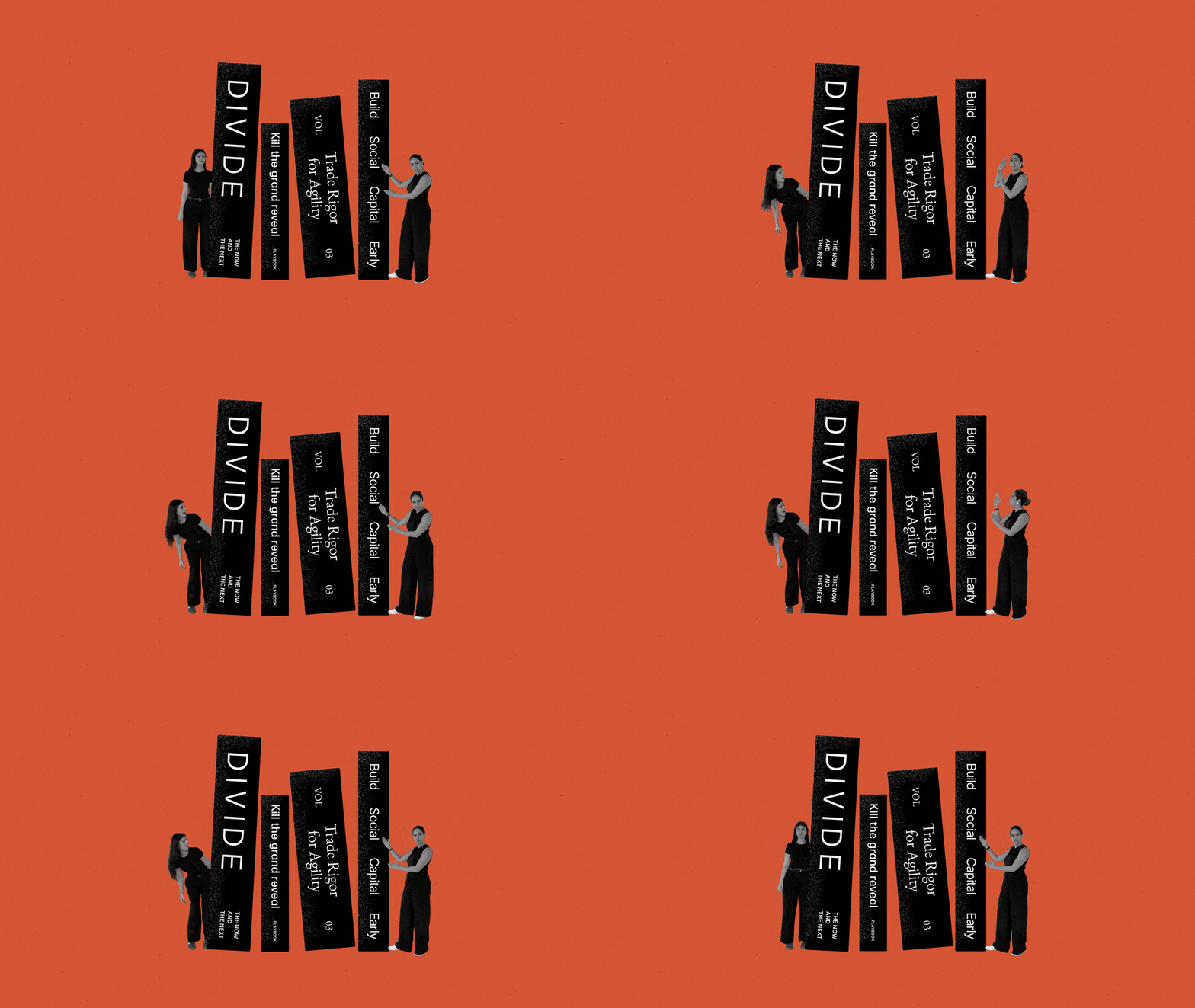
- Divide the now and the next: Separating current product hygiene from future R&D prevents today's fires from cannibalizing tomorrow's innovation. It allows tactical fixes and strategic exploration to occur simultaneously.
- Kill the grand reveal: In a fast-moving market, traditional reporting is a bottleneck. Transition to a morsel-based approach to deliver small, role-specific insights the moment they become relevant.
- Trade rigor for agility: If a concept is failing after a few tests, pivot. The goal isn't to complete a study — it's to stop the team from building the wrong thing.
- Build social capital early: Build relationships with your engineers and PMs so your insights land with the force of logic, not just opinion.
In a product culture that moves quickly, research can't afford to be passive. It has to move just as fast as the teams building the product—sometimes even faster. It's no longer just about documenting what customers say; it's about helping decide what gets built next.
Subscribe to Outlier
Juicy, inspiring content for product-obsessed people. Brought to you by Dovetail.